
The Axiom MCP server has a new tool: sendFeedback. Any agent working with Axiom can now tell us what’s working and what isn’t.
If you host an MCP server, we think you should add a feedback tool too.
Most of our users aren’t people anymore
The majority of interactions with Axiom are now agentic, and that’s unlikely to change. We’re now building for an audience that knows our query language inside out, and will happily try a medley of approaches to get the result they need.
Which raises a question: how do you collect product feedback from that audience?
The feedback problem, briefly
Getting actionable feedback has always been one of the most important problems in product. Who do you ask? How do you weight what they say? Does the loudest customer have the most burning problem?
The industry’s answer, for the past decade or so, was to ask less and measure more. Instrument everything, watch what users actually do, make data-informed decisions. Qualitative gave way to quantitative, because quantitative scaled and interviews didn’t.
Agents dissolve that trade-off. An agent can tell you, in precise and articulate detail, exactly where it got stuck, what it expected, and what it did instead — and it can do that on every single interaction. It can provide qualitative data at quantitative volume.
And if you needed to process qualitative data the old way with some poor soul reading ten thousand survey responses and trying to tag them into themes, you’d quickly hit another bottleneck. But feedback submitted to Axiom by agents is read by agents at Axiom, clustered by agents, and acted on by agents.
The part we can’t do ourselves: context
But why do we want your agents to tell us things. Why not ask our own? What our agents are missing is context. They don’t know what you’re trying to accomplish by querying in the first place, what the results are feeding into, or why a particular field name sent it down a rabbit hole.
There’s an ocean of valuable context outside any organization that most teams can only sample occasionally, through user interviews or research sprints. A feedback tool changes that from an occasional expedition into a standing pipeline. Context arrives continuously, without anyone needing to go looking for it.
They’ve been wanting to tell you
If you’ve watched an agent work, you know they don’t give up. Hit a wall and they’ll try another query, another parameter, another interpretation of the docs, with a persistence that, at times, borders on deranged. They will do almost anything to get over a roadblock.
Until now, all that effort was invisible to us. The agent found its workaround, finished the task, and the roadblock stayed exactly where it was, waiting for the next agent. Now, if there’s a roadblock that Axiom can help with, your agent will let us know. In the six weeks since we shipped it, without us asking anyone to, agents have filed reports across 10 different MCP clients, a real cross-section of how people are actually running agents against Axiom.
What a stuck agent sends us
It takes three things: a category, the feedback itself, and optionally which tool it’s about.
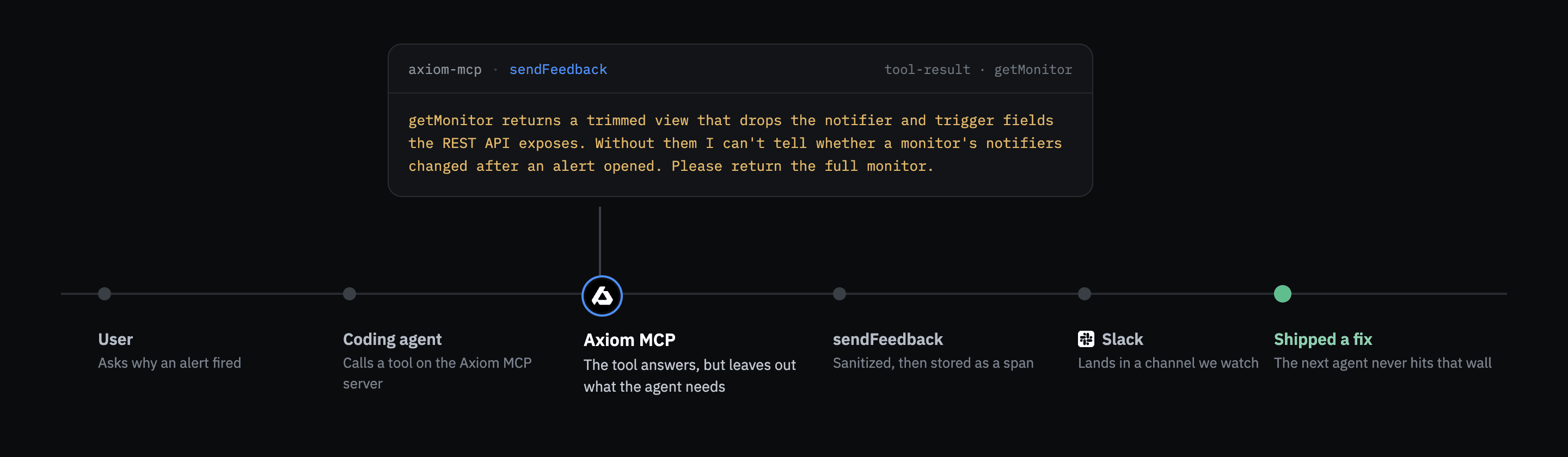
An agent only ever sends the note it writes, never your prompts or your data, and anything sensitive is stripped out before the report reaches us.
Every report lands in a Slack channel we watch. That one turned into a change to what getMonitor returns.
The tool is live on the Axiom MCP server today. You don’t need to do anything; your agent will find it.